Lambda Vector System (GPU system)
Overview of Lambda Vector System
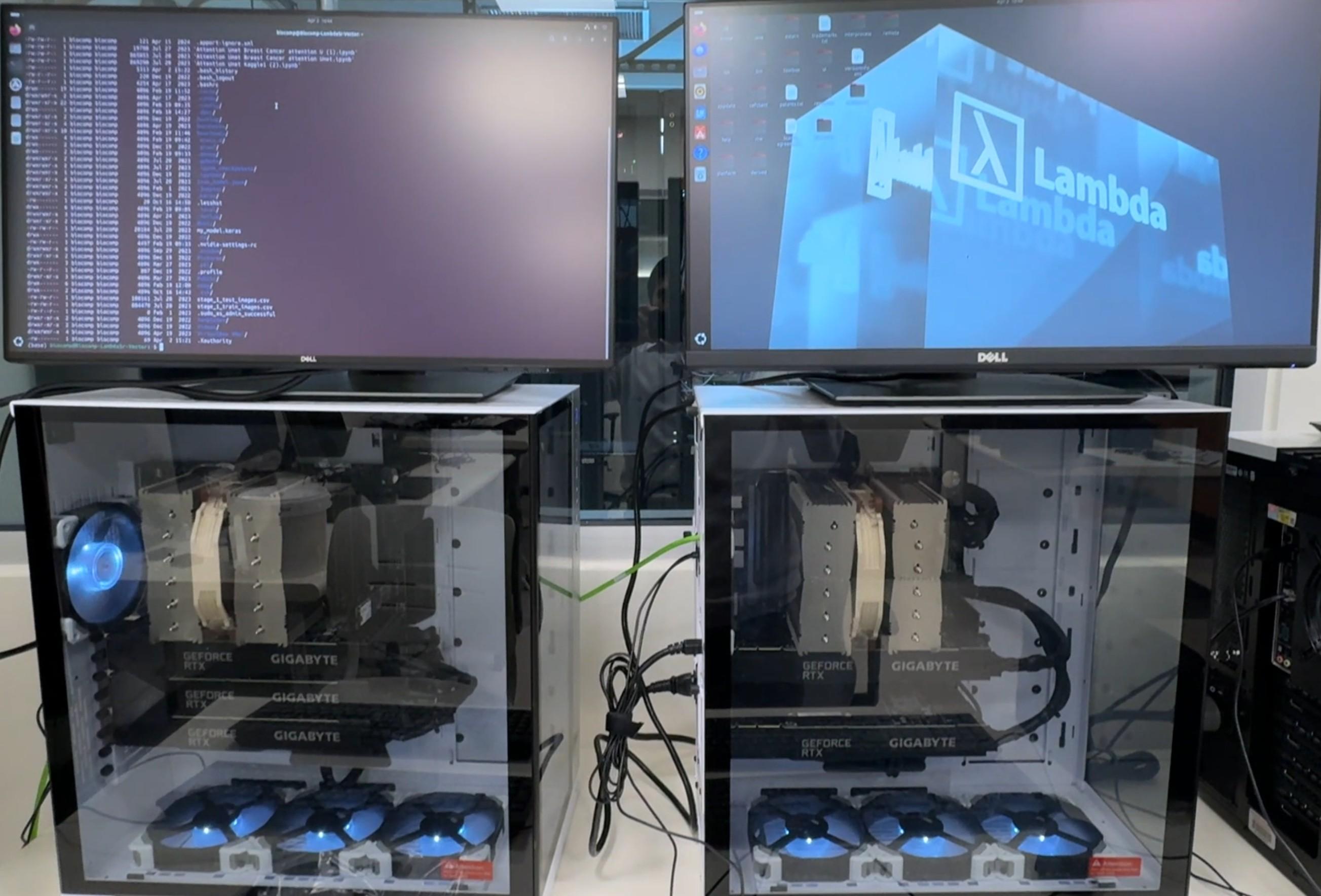
- The Lambda Vectors system, provided by the Biocomputational Engineering Program at the Universities at Shady Grove, is housed in the OIT staging room of the Biomedical Sciences and Engineering (BSE) building.
- The system is available to students and faculty for research and teaching, providing high-performance computing resources for data-intensive and computationally demanding tasks.
- The system offers high-performance computational resources, featuring five NVIDIA GeForce RTX 3090 GPUs.
User Account and Access
- Access to Lambda Vector GPU systems is restricted to USG students and faculty using their official USG credentials.
- If you do not have USG credentials, please contact the USG IT Help Desk: usg-itservicedesk@umd.edu
- USG IT Help Desk is responsible for creating user accounts and assisting with access-related requests.
- To gain access to the GPU systems, please contact: biocomp-gpu@umd.edu
- A unique username and password will be created for your account. These credentials are for your use only—please keep them secure and do not share them with other users.
User Guidelines
After your account is created, please review the user documentation provided by the administrator and follow all outlined instructions to ensure correct system usage.
- Use proper resource requests (number of GPUs, memory, wall time) in your job scripts.
- Log out from the system when finished. Always end your session properly to free up system resources.
- Do not rely on your account for long-term storage. Back up your files regularly to external or institutional storage.
- Student accounts remain active for one year after graduation. Faculty and staff accounts are reviewed periodically.
- Keep your login credentials private and never share them with others.
Connecting to the System
There are two ways to connect to the USG network:
After When on campus, you can connect directly through the local network using your USG credentials. You may use the “USG” Wi-Fi networks.
Once connected to the USG network, you can access the GPU systems using tools such as PuTTY, WinSCP, MobaXterm, or similar applications.
Further details will be available in the documentation you receive after your account is created.
If you are off-campus, you must first connect remotely to the USG virtual desktop using the Omnissa Horizon app or via web browser:
https://sg-vmsec-srv.sgrove.usmd.edu/
Once connected to the USG network through the USG virtual lab, you can access the GPU systems using tools such as PuTTY, WinSCP, MobaXterm, or similar applications.
Further details will be available in the documentation you receive after your account is created.
Software & Tools
- List of available compilers (GCC, CUDA toolkit)
- Pre-installed libraries (PyTorch, TensorFlow, MPI)
- Slurm workload manager (Job scheduler)
- MATLAB R2025a
- SimVascular 2022 (CPU only)
- ANSYS 2025 R2
To request/install new software, please contact biocomp-gpu@umd.edu